

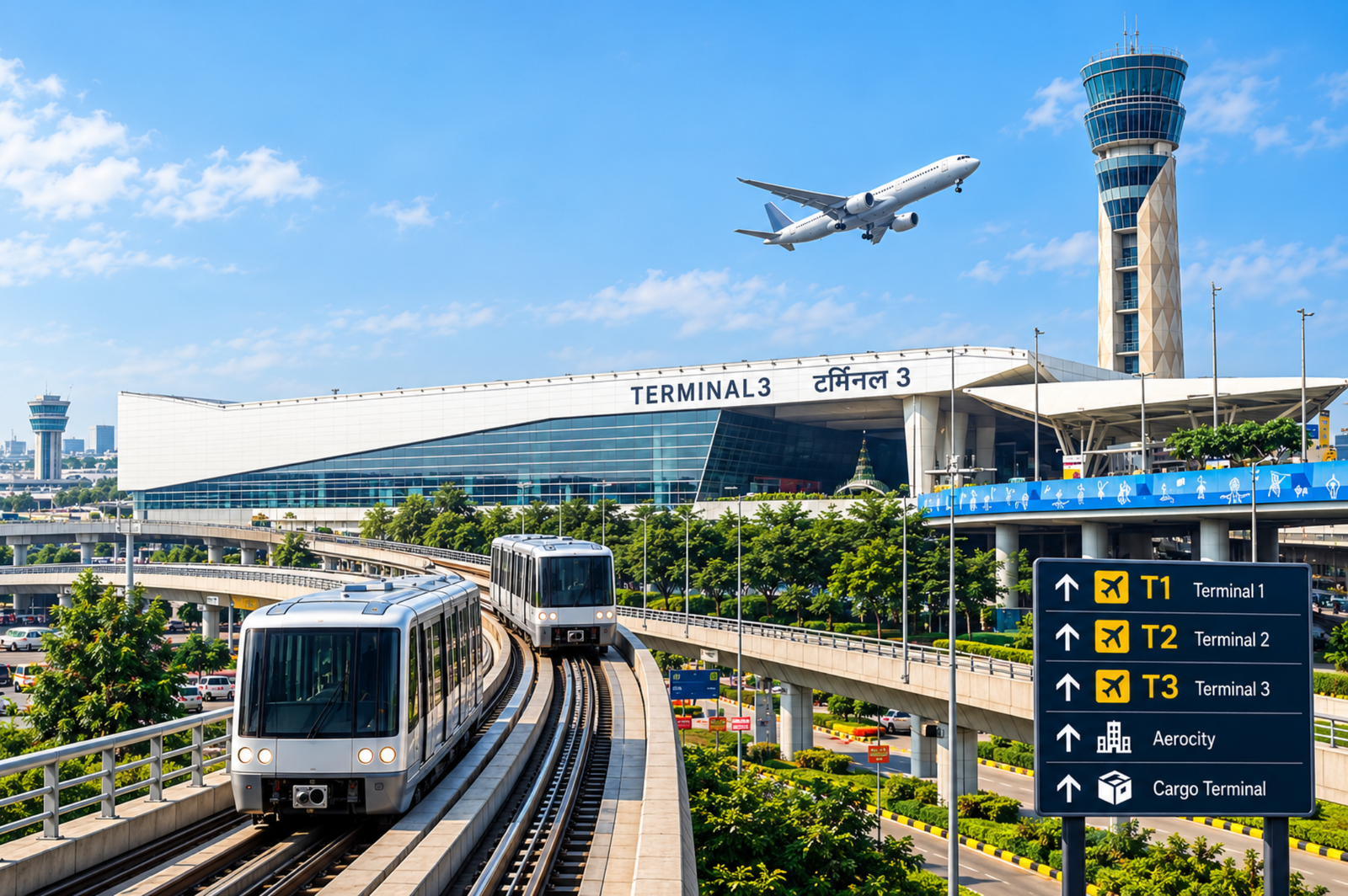
Delhi’s Indira Gandhi International Airport (IGIA) is set to receive a major inter-terminal connectivity upgrade, with plans for an Automated People Mover (APM) to connect its passenger terminals and key airport facilities by 2030.

The proposed driverless transit system is expected to involve an investment of approximately ₹3,500 crore and forms part of Delhi Airport’s broader 10-year master plan through 2036.
7.3-km Automated Transit System
The proposed APM will span approximately 7.3 kilometres and feature six stations.
The system is planned to connect Terminal 1, Terminal 2, Terminal 3, Aerocity and the airport’s cargo facilities. One of the stations will also provide connectivity to the Delhi Metro network.
The APM is expected to significantly improve passenger movement within the airport, particularly between T1 and T3, which are located several kilometres apart.
T1 to T3 in Around 13 Minutes
Under the current plan, passengers will be able to travel between Terminal 1 and Terminal 3 in approximately 13 minutes.
The system is expected to operate at intervals of around 10 minutes, providing a dedicated alternative to road transport for passengers transferring between terminals.
The APM is projected to carry approximately 55,000 passengers per day during its first year of operation, with ridership expected to increase as airport traffic grows.
Part of a Larger Airport Expansion
The APM is being planned alongside significant capacity expansion at Delhi Airport.
The airport currently has an annual passenger-handling capacity of approximately 106 million passengers across its three terminals. Under the master plan, this is expected to increase to around 125 million passengers annually, with potential capacity of up to 129 million.
Terminal 3 is also planned for further expansion, including the development of a new Pier E, while additional check-in facilities, security screening infrastructure, parking stands and road improvements are also part of the broader development programme.
Building Connectivity for a Growing Airport
The proposed APM is intended to address one of Delhi Airport’s key passenger-movement challenges: transferring between terminals that are separated by several kilometres.
With passenger traffic continuing to grow, the dedicated transit system is expected to improve terminal connectivity, reduce dependence on road transfers and make movement within the airport more efficient.
If delivered as planned, the APM will become a significant piece of Delhi Airport’s infrastructure as the airport prepares for substantially higher passenger volumes over the coming decade.