

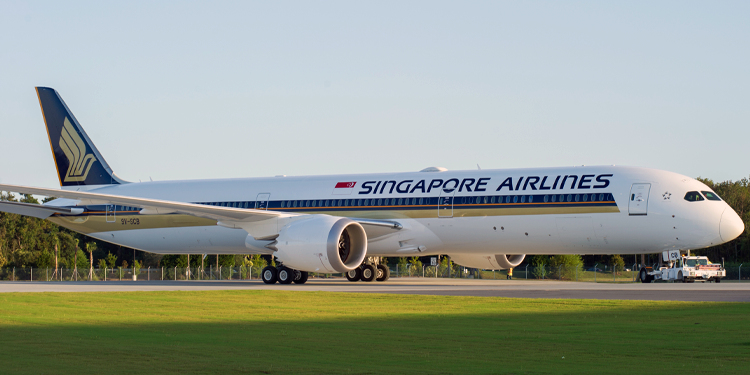
Singapore Airlines Group reported a net loss of S$76 million for the first quarter of FY2026/27, despite recording its highest-ever quarterly revenue of S$5.714 billion.

The airline group said strong demand for air travel and higher passenger yields helped drive revenue up 19.3% year-on-year, but the sharp increase in jet fuel costs significantly impacted profitability.
SIA and Scoot carried a combined 10.9 million passengers during the quarter ended 30 June 2026, an increase of 6.3% compared with the same period last year. Passenger revenue rose 18.6% to S$4.582 billion, while passenger yields increased 12%.
The Group’s passenger load factor stood at 87.1%, slightly lower than the previous year as capacity expanded faster than traffic.
FUEL COSTS HIT PROFITS
The biggest pressure came from fuel.
SIA Group’s net fuel cost increased 78.5% to S$2.253 billion, an increase of S$991 million. Fuel costs before hedging more than doubled, rising 118.7%, as jet fuel prices surged following the escalation of the Middle East conflict.
Despite a fuel hedging gain of S$376 million, the sharp rise in fuel expenditure pushed total Group expenditure up 27.9% to S$5.609 billion.
As a result, operating profit fell 73.8% from S$405 million to S$106 million.
The Group ultimately reported a S$76 million net loss, compared with a S$186 million net profit in the first quarter of FY2025/26. SIA said the deterioration was mainly due to the lower operating profit and a higher share of losses from Air India.
CARGO PERFORMANCE REMAINS STRONG
Cargo operations provided some support, with cargo revenue increasing 33.5% to S$708 million.
Cargo yields improved by 28.1%, while the cargo load factor increased from 56.9% to 58.8%. Cargo loads increased 4%, compared with only 0.5% growth in capacity.
SIA said demand remains resilient across key cargo sectors, particularly movements related to semiconductors and data centres.
FLEET AND NETWORK EXPANSION CONTINUES
Despite the financial pressure, SIA Group continues to expand its network and fleet.
During the quarter, the Group took delivery of one Airbus A320neo and three Boeing 737-8 aircraft. Its operating fleet stood at 220 aircraft as of 30 June 2026, with another 62 aircraft on order.
The Group’s passenger network covered 137 destinations across 36 countries and territories, with Singapore Airlines serving 78 destinations and Scoot serving 85.
SIA has also announced further network expansion, including increased capacity to Europe and Australia and the launch of five-times-weekly services to Madrid via Barcelona from 26 October 2026.
SIA will also begin daily services to Western Sydney International Airport from November 2026, taking its total services to Sydney to five times daily.
MIDDLE EAST CONFLICT CONTINUES TO AFFECT OPERATIONS
The ongoing Middle East conflict remains a major uncertainty for the Group.
Scoot resumed services to Jeddah in June but suspended them again from 14 July following the escalation of the conflict. SIA’s services to Dubai remain suspended, while the planned launch of services to Riyadh has been deferred to December 2026.
The airline said it will continue to monitor developments and adjust flight schedules as necessary.
SIA TO UNVEIL NEW CABIN EXPERIENCE
SIA is also preparing a major upgrade to its passenger experience.
The airline plans to unveil an all-new in-flight travel experience later in 2026, including next-generation long-haul cabin products, an updated KrisWorld entertainment system, enhanced in-flight dining and new amenity kits.
From 2027, SIA will progressively introduce Starlink satellite-based broadband connectivity across its aircraft.
OUTLOOK
SIA said demand for air travel remains robust, supported by seasonal travel flows, while cargo demand continues to show resilience.
However, elevated jet fuel prices remain a significant cost challenge. The airline has adjusted air fares and cargo rates to help offset higher fuel costs, but said these measures do not fully compensate for the increase in fuel expenditure.
Despite the challenging environment, SIA said its strong balance sheet, diversified passenger and cargo network, and dual-brand strategy with Scoot provide flexibility to respond to changing demand.
As of 30 June 2026, the Group held S$9.10 billion in cash and bank balances, plus S$1.38 billion in longer-term fixed deposits and access to S$3.24 billion in undrawn committed credit lines.