

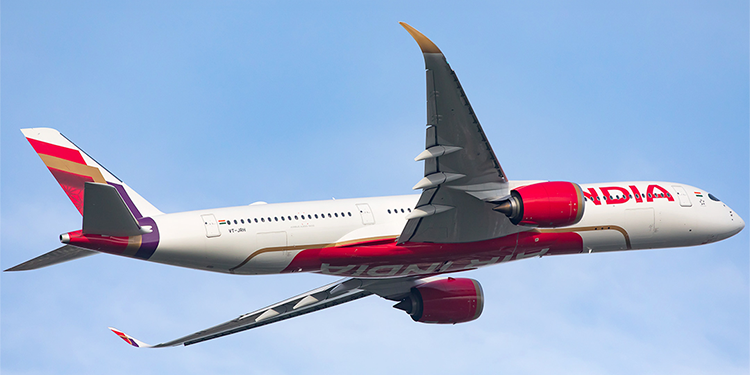
Air India has announced the operation of 36 additional international flights to Europe and Canada between 19 and 28 March 2026, as the Tata Group-owned carrier continues to recalibrate its long-haul network in response to ongoing disruptions across West Asian airspace.

The move comes as part of a broader strategy to maintain connectivity and absorb surging passenger demand at a time when traditional routings via the Gulf remain constrained due to geopolitical instability.
Capacity boost to stabilise long-haul connectivity
According to the airline’s latest press communication, the additional services are being deployed to ease capacity pressures on key trunk routes linking India with Europe and North America, particularly Canada. The temporary expansion follows a similar capacity injection earlier this month, when Air India operated 78 additional flights across multiple long-haul sectors.
Industry sources indicate that these supplementary flights are not merely demand-driven, but also aimed at mitigating operational disruptions caused by restricted airspace availability in parts of West Asia, which has forced airlines to adopt longer and more complex routings.
Strategic response to evolving airspace constraints
Air India has, over the past two weeks, been progressively adjusting its international schedule. With several Middle Eastern corridors either restricted or avoided, flights between India and western destinations are being operated via alternative routings over regions such as Oman, Saudi Arabia, and Egypt, often resulting in extended block times and technical stops on select North American sectors.
This has created a cascading effect on aircraft utilisation and scheduling, making additional frequencies a necessary buffer to maintain network reliability.
Focus on passenger accommodation
The airline has clarified that these flights are intended to support passengers impacted by earlier disruptions, with priority likely being given to those holding existing bookings. Similar measures were seen in earlier advisories, where Air India facilitated rebooking and flexible travel options for affected travellers.
The latest tranche of 36 flights is expected to enhance seat availability during a peak travel window, particularly for students, diaspora traffic, and business travellers moving between India, Europe, and Canada.
A pattern of adaptive network planning
This development reflects a broader trend in Air India’s current operational playbook—dynamic capacity deployment in response to geopolitical volatility. Since early March, the airline has:
- Added 78 extra flights on Europe, US, and regional routes (10–18 March)
- Introduced ad-hoc services to West Asia to repatriate stranded passengers
- Continued long-haul operations via extended, fuel-intensive routings
Together, these steps underline Air India’s attempt to balance operational resilience with commercial demand, at a time when global aviation networks are once again being tested by geopolitical shocks.
While the additional 36 flights provide short-term relief, the situation remains fluid. Much will depend on how quickly normal airspace access is restored across West Asia. Until then, airlines like Air India are expected to continue relying on capacity injections, flexible scheduling, and alternate routings to sustain their long-haul networks.